Both Barisan Nasional and Pakatan Rakyat have advocated that Malaysia should shift from race-based affirmative action (AA) to need-based affirmative action[1].
The idea seems sensible and equitable. It appears we have finally discovered a wonderful formula that can shift us away from the rancourous debates over race-based AA, the New Economic Policy and its successors.
Sadly, the idea that we can replace race-based affirmative action with need-based affirmative is deeply flawed on both conceptual and practical grounds. In Malaysia, poverty reduction has been conflated with affirmative action, which results in the confusion we have today.
Affirmative action is principally not about poverty alleviation or need-based distribution. At root, it aims to empower a disadvantaged group through elevating individuals from that group to positions in the upper rungs of the educational and occupational ladders. The framers of the NEP set out two prongs:
(1) to eradicate poverty irrespective of race; and
(2) to accelerate the restructuring of society to reduce and eventually eliminate the identification of race with economic function.
The second prong corresponds with affirmative action.
Affirmative action has a specific objective: to increase the participation of a disadvantaged group in positions that confer social esteem and economic influence – for example, in tertiary education, high-level occupations, asset ownership. Bumiputeras were overwhelmingly under-represented in the ranks of university graduates, managers and professionals, and equity owners when the NEP was formulated in the 1970s[2].
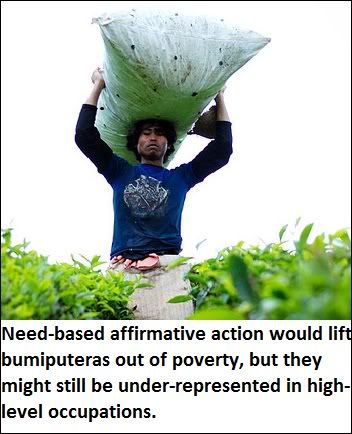
Pakatan Rakyat and Barisan Nasional both claim need-based AA focused on the poor will help mainly Bumiputeras, since most of the poor are Bumiputra. That is true. An effective need-based AA programme would indeed lift thousands out of poverty. But, it will not necessarily result in eliminating the identification of race with economic function. Bumiputeras would be lifted out of poverty, but might still be under-represented in high-level occupations.
An example will help. Let us say, for example, a needs-based policy targeting the bottom 40% of households surviving on an average RM1,500 per month is implemented. Let us say we deliver a mix of direct cash payments, child-care support and education and training assistance with the aim of uplifting household incomes. Implemented correctly, effectively and with integrity, let’s say we are phenomenally successful and manage to lift incomes dramatically.
Most of the poor households that see improved incomes and living conditions would be bumiputera, as they form more than ¾ of this group[3]. But these higher incomes might well have come from being better skilled workers or more productive small traders and hawkers. Bumiputeras might well still be overwhelmingly under-represented in high-level occupations.
How then would we increase Bumiputera representation in professional and management positions?
Let us say we decide to increase the number of Bumiputera accountants via a need-based policy. Accounting firms, when evaluating job candidates, would have to verify and evaluate applicants’ parents’ income and assets to determine who’s poorer and should be given priority. Three major issues surface:
It would undermine a basic foundation of functional economies – that labour market entry and mobility correspond primarily with ability, not need;
It would be at odds with the principle that adults are independent from their parents and responsible for themselves; and
It would inflict upon the private sector a very complicated and costly process for which there is no benefit. In fact, it would force employers to pursue a very dubious and ineffective policy of hiring and promoting professionals and managers on the basis of socio-economic background, not ability.
It should now be clear that affirmative action is unavoidably race-based if the aim is to increase Bumiputera representation in professional and management positions. It is delusional to believe need-based AA can replace race-based AA. In employment, the choice is really between race-based AA or no AA at all.
At this point, we must now admit a hard truth: affirmative action is inherently discriminatory. It confers preference toward a beneficiary group who are less qualified than other candidates. This discrimination is warranted by the fact that structural impediments in society had unfairly prevented this group from gaining the requisite qualifications, opportunities and work experience to compete on an equal footing.
Now, more than 40 years after the NEP was conceived, is a time for stock-taking and honest evaluation. The chasm between those defending the privileged status quo and those calling for meritocracy must be bridged. Critical issues must be rationally discussed:
Firstly, a thorough review of the achievements so far, and the costs involved must be conducted, widely disseminated and discussed. How successful have we been in (1) eradicating poverty irrespective of race; and (2) eliminating the identification of race with economic function?
Secondly, clear new targets and approaches must be set, after consultations with all stakeholders. In this regard, the foundation for success is a fundamental shift in attitude and educational content. We must start by addressing shortcomings in the education system, especially the matriculation programmes and under-challenging environments[4] that most Bumiputera graduates pass through. Beneficiaries must be imbued with self-confidence and a responsibility to excel because preferential treatment will be temporary. Blind allegiance to a party-state seeking permanent patronage must be rejected.
Effective affirmative action demands focus on developing capability and self-reliance, especially through attaining tertiary education and accumulating work experience.
For AA to be effective, we should select those within the beneficiary group who are most capable of coping with the challenges of upward mobility. This is difficult but it must be done, and it must be done productively, effectively and temporarily. Over time, the need for preferential selection should diminish, and the groundwork will be laid for rolling back the AA regime.
As the debate currently stands, we are locked in a triangular stalemate, between those who defend race-based AA regardless of cost, those who demand its swift abolition without thinking of viability, and those who press for a vague and incoherent concept of need-based AA. We should instead be making race-based AA more effective while preparing to roll it back.
Dr Lee Hwok Aun
11 January 2012


 11:53
11:53
 Sang Jebat





 Posted in: